
Why a Book About PPM Best Practices?
I wrote it because after three decades in project and portfolio management, the gap between the discipline and the technology has not closed. Microsoft shipped Microsoft Project twelve years before PMI® published the first edition of the PMBOK® Guide, and a generation of project managers learned the discipline not from a published standard but from a piece of software. AI is arriving the same way now, ahead of any settled practice for using it. The book’s introduction tells that story properly.
The right sequence has not changed. Decide what the practice is, then choose technology that runs it. In the years before I founded Sensei Project Solutions™ I worked with hundreds of clients, and nearly every one was building the same practice from scratch at its own expense. Nobody had ever handed them the complete practice in one place.
Knowing the practice a PMO should run has never been the hard part. Keeping the discipline is.
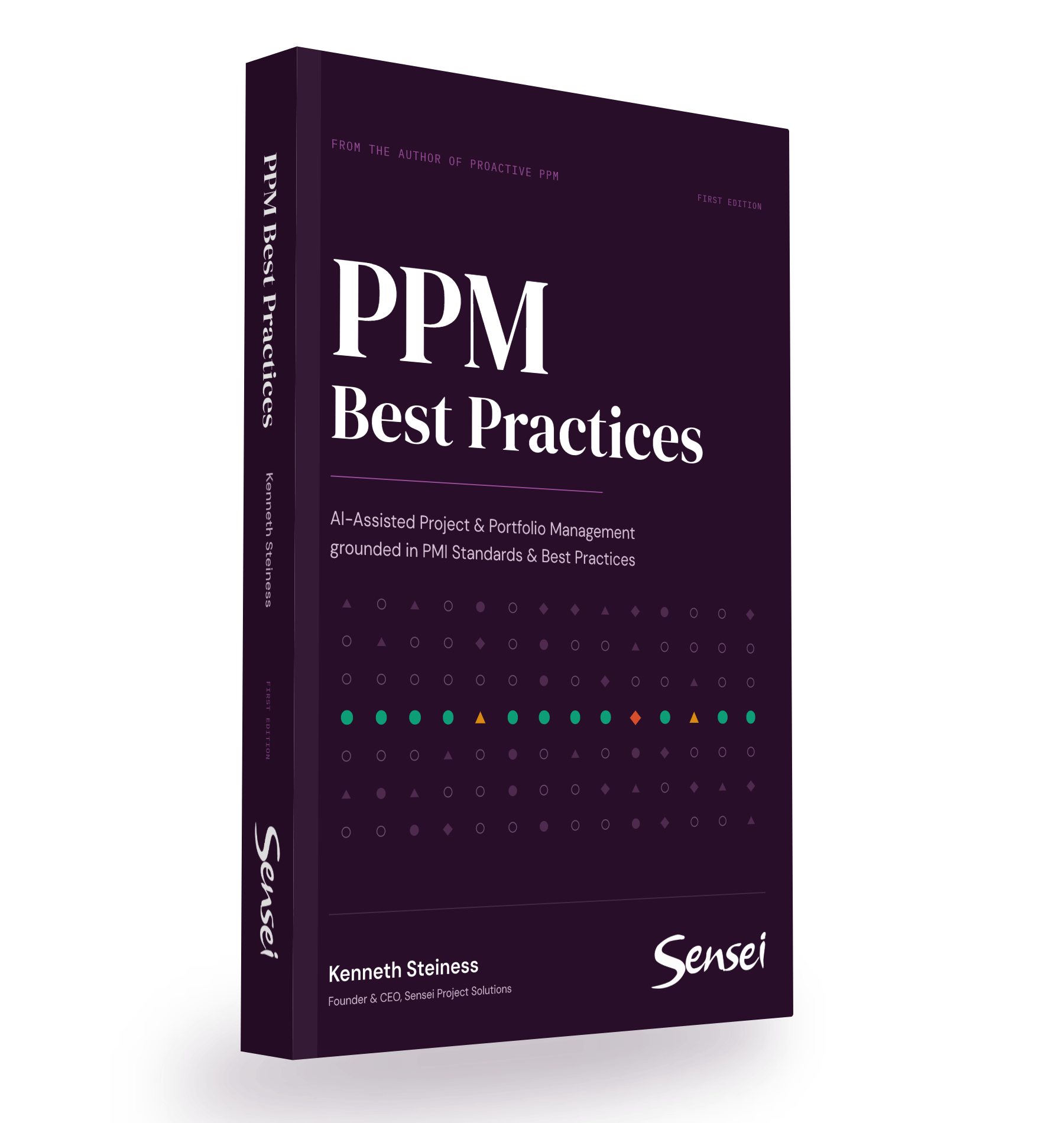
What the Book Is
PPM Best Practices is a working handbook for the PMO director, whatever their actual title, and for the portfolio, program, project and resource managers working to the process the PMO sets. Its 26 chapters run from project governance through resource capacity to benefits realization. Each one takes a single practice and settles what has to be true for it to work: the meeting, the frequency, the owner and the threshold.
Every chapter is grounded in the PMI Standards, with the citations inline so you can defend the practice to a steering committee without rereading a shelf of standards. Behind the citations sits three decades of field experience, which is what turns those standards into something a PMO can run.
Nothing here asks for more process than your organization needs. The chapters say so as they go, which is the opposite of the maturity ladder that tells you the top rung is the goal.
Every Chapter Has Two Halves
Part 1 is the practice. What has to be settled, who owns it, how often it runs and what puts something on the agenda. That half works in any organization with any toolset. It also says where AI can take the first pass: drafting a risk response, writing a status narrative, explaining a variance nobody has looked at yet. Those scenarios are written generically, because the practice matters whatever you run it on.
Part 2 shows the same practice running end to end in Sensei IQ™, which is built to run it. You do not have to construct it, and it grows with you.
Read the halves in that order and the book works as a methodology book. Read only the first halves and it still works, which is the test I set for every chapter before it was written.
What It Covers
The Foundations chapters make the argument before any practice appears. Why PPM Best Practices Pay Off defines the disciplines and sets the test a practice has to pass to be called best practice. Aligning to PMI Standards names the standards the book leans on and what each is for. Right-Sizing the Practice states the sufficiency principle the rest of the book runs on.
Project management is the longest stretch, and it is the registers and cadences a delivery organization lives inside. Project Governance covers lifecycle stages and gates. Work Management Tools and Delivery Approaches covers predictive, agile and hybrid delivery and how work reaches the PMO. Then the practices themselves: Deliverables, Key Dates, Financials, Risks, Issues, Change Requests, Decisions, Status Updates and Lessons Learned. Project Reporting sets the reporting principles the rest of the book applies: exception reporting, surfacing what needs attention, and disciplined use of color. Microsoft Teams as the Hub for PPM covers where the project conversation lives.
Program and portfolio management moves up an altitude. Intake and the Business Case covers the front door, Business Case Prioritization covers how investments are scored against each other, and Programs and Portfolios cover the roll-ups, and make the case that a portfolio should follow who decides what gets funded and stopped rather than the org chart. Program and Portfolio Reporting takes the reporting principles to executive altitude.
Resource management is built as three levels, because they answer three different questions. Level 1: Who’s Working on What When? is visibility across every connected work management tool. Level 2: Resource Availability is where the capacity answer lives, through a formal request and allocation process. Level 3: Timesheets is time capture at the precision your decisions require, and no more.
Strategy closes the book. Strategy Alignment covers strategic themes, the goals beneath them and the alignment of projects to both. Benefits Realization covers benefits defined and tracked against those goals, and it is where the book’s argument about how much practice is enough lands hardest.
At the back are nine one-page practice checklists, one for each of the registers above, from Deliverables through Lessons Learned. A chapter tells you what to settle; the checklist is what you take into the room.
How to Read It
Read it as a workbook rather than front to back. Take the practice you know your PMO runs worst. Settle what that chapter asks you to settle, run the cadence it names for a quarter, then come back for the next one.
Start where you are. Add structure only when the practice you have stops answering the questions your leadership is asking.